
Wake County Criminal Court Cases
Wake County belongs to Prosecutorial, Superior Court, and District Court District 10. Superior Court tries felonies. District Court hears misdemeanors and infractions, and it handles the first stages of felony cases before indictment and transfer. Both divisions conduct criminal business at the Wake County Justice Center, 300 South Salisbury Street in Raleigh. The criminal court number is (919) 792-4300, while the separate records and expunction line is (919) 792-4325.
The Clerk of Superior Court is the record custodian for both levels. That title often causes a bad assumption that District Court has another clerk. It does not. A Wake County criminal case file may begin with a citation, magistrate order, warrant, information, or indictment. It then gains settings, motions, pleas, orders, and a disposition as the case moves. Raleigh, Cary, and Apex have no municipal criminal courts, so city police charges also enter the state District or Superior Court structure.
The Judicial Branch Wake County court page identifies the local court divisions and current services.
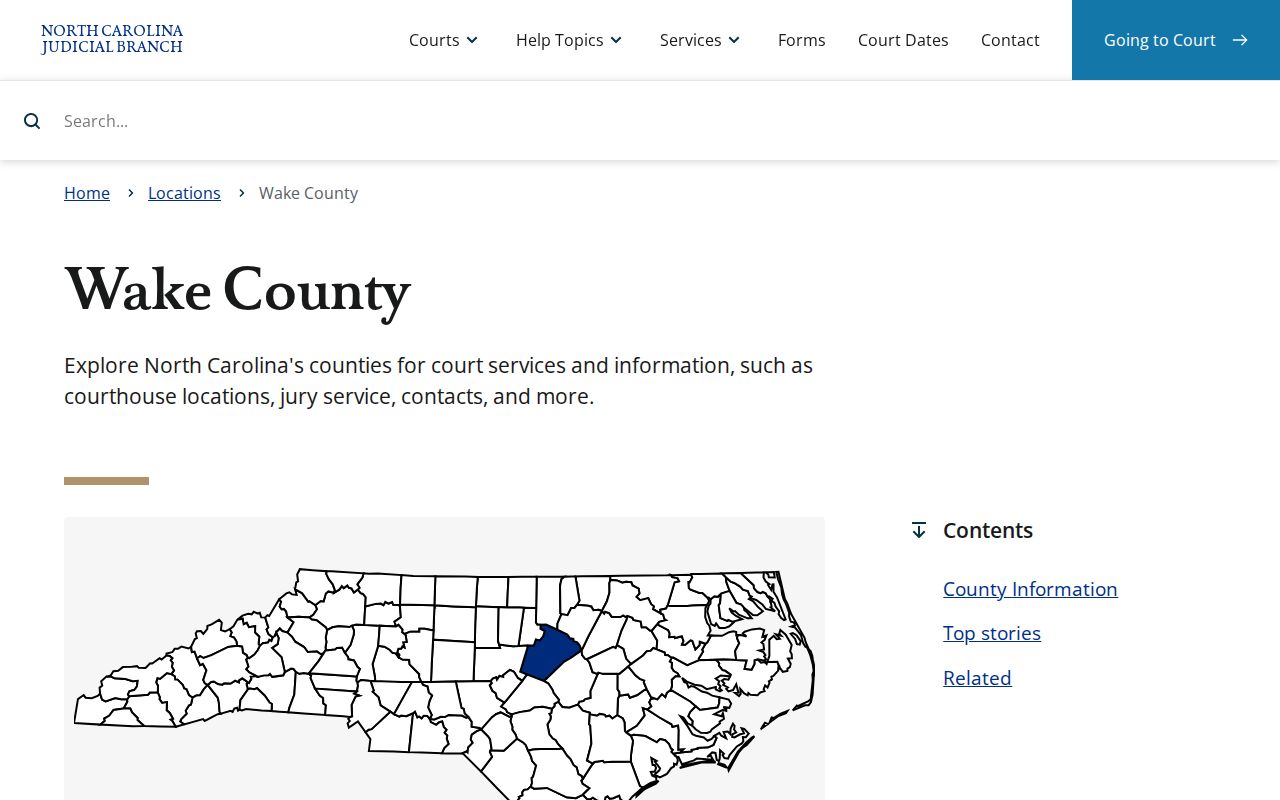
The official Wake County landing page is the sound place to confirm calendars, forms, closures, and office changes before relying on old instructions.
Wake County District and Superior Cases
The Wake County court name attached to an event tells a reader what stage and charge level may be involved. District Court owns misdemeanor trials, infractions, and preliminary felony work. A felony prosecution can later appear in Superior Court after a grand jury returns an indictment. One Wake County incident may therefore create entries at more than one level, and a name-only result should never be read without its case number, charge, filing date, and division.
| Court or counter | Record role | Contact |
|---|---|---|
| Wake District Court | Misdemeanors, infractions, and early felony proceedings | (919) 792-4300 |
| Wake Superior Court | Felony case files, trials, and judgments | (919) 792-4300 |
| Clerk records counter | Record checks, copies, and expunction routing | (919) 792-4325 |
| Magistrates | Initial process and release conditions | (919) 792-4900 |
North Carolina class labels add context, but they are not Wake County outcomes. Felony Classes A through I use the structured-sentencing grid in G.S. 15A-1340.17 and go to Superior Court for trial. Misdemeanor Classes A1 through 3 use G.S. 15A-1340.23 and go to District Court. The conviction offense and judgment, not the booking label, control any final sentencing analysis.
Searching Wake County Case Records
The North Carolina eCourts Portal is the main remote index. Wake County was an early eCourts pilot in 2023, and all 100 counties used the platform by October 2025. Portal terms can shift with software releases, but the basic method remains stable. Search narrowly, verify the person, and inspect each case rather than treating a result list as one history.
- Choose the public or Smart Search route and select a person or case-number search.
- Enter the last name with a first name, or use the full file number when known.
- Narrow the result to Wake County, criminal or traffic cases, and a useful filed-date range.
- Open the register of actions and check charge, court division, status, hearings, and disposition.
- Use a clerk terminal or ask the records counter for the paper file, plain copy, or certified copy when Portal lacks the needed item.
| Field label | Type | Required | Notes |
|---|---|---|---|
| Person or case | Tab or selector | One route | Choose the type of search first |
| Last name | Text | Name route | Test valid spelling variations |
| First name | Text | Not stated | Use it to narrow common names |
| Case number | Text | Case route | Examples resemble YYCRS###### or YYCR###### |
| County and type | Filters | Optional | Select Wake and criminal or traffic |
| Filed date | Date filter | Optional | Useful for common-name results |
Note: Portal is a case index, not the SBI fingerprint-supported criminal history kept for a person's own official review.
Reading Wake County eCourts Case Records
A Wake County register of actions is a timeline. It may show the filing, service of process, court settings, continuances, plea, trial, judgment, or an order for arrest. “Pending” means there is no final disposition. It does not mean guilt. “Dismissed” means the charge ended without a conviction, but it does not itself erase the older booking or agency report. A guilty plea and a guilty verdict are convictions.
- Disposition
- The court's outcome, such as conviction, dismissal, or acquittal.
- Arraignment
- The proceeding where the charge is formally addressed and a plea may be entered.
- Indictment
- A grand jury's formal felony accusation, not proof of guilt.
- Order for arrest
- North Carolina process directing law enforcement to take a person into custody.
- Docket
- The chronological index of filings and court events.
The official court-record access instructions explain the difference among Portal, the public terminal, and the paper file.
Those Wake County channels matter when a screen shows an event but does not provide the underlying motion, order, or judgment as a remote document.
Inside a Wake County Case File
The full Wake County criminal case file is a court record, not an arrest log. It connects the filed accusation to the later ruling. A useful review starts at the case header, follows the event list, then ends with the disposition and judgment. Costs or balances may appear, but a payment entry alone does not explain the legal outcome.
| Case number and court | File number, Wake location, division, type, filing date, and status |
|---|---|
| Charging record | Offense description, statute, class, offense date, and filed process |
| Parties and counsel | State, defendant, and counsel where entered |
| Docket entries | Process, settings, continuances, motions, plea, trial, and orders |
| Hearings | Date, time, courtroom or session, and event type |
| Disposition and judgment | Dismissed, guilty, not guilty, transferred, or another coded result |
| Sentence and money | Custody or community term, probation, conditions, costs, fines, and restitution where public |
In Wake County, full Social Security numbers, protected birth data, juvenile material, victim information, expunged matters, and sealed filings are not open fields. The clerk can explain what is available, but staff cannot change a valid court order or give legal advice.
Wake County Clerk Holds Both Dockets
The Wake County criminal file is at the Justice Center, not the older Wake County Courthouse at 316 Fayetteville Street, which remains the civil venue. Public terminals allow searches by defendant name, case number, or victim and witness name where the system permits. The actual paper file must be inspected in the county where it is maintained. This is why a terminal in another county can help locate a case, yet the Wake clerk remains the source for the local paper record and certification.
Wake County Justice Center
Clerk of Superior Court, criminal divisions
300 S. Salisbury St.
Raleigh, NC 27601
(919) 792-4300
Weekdays, 8:30 a.m. to 5 p.m.
Records and Expunctions
Same Justice Center
Record checks, copies, and expunction routing
(919) 792-4325
The Wake court payment page lists current ways to pay eligible fines and fees.
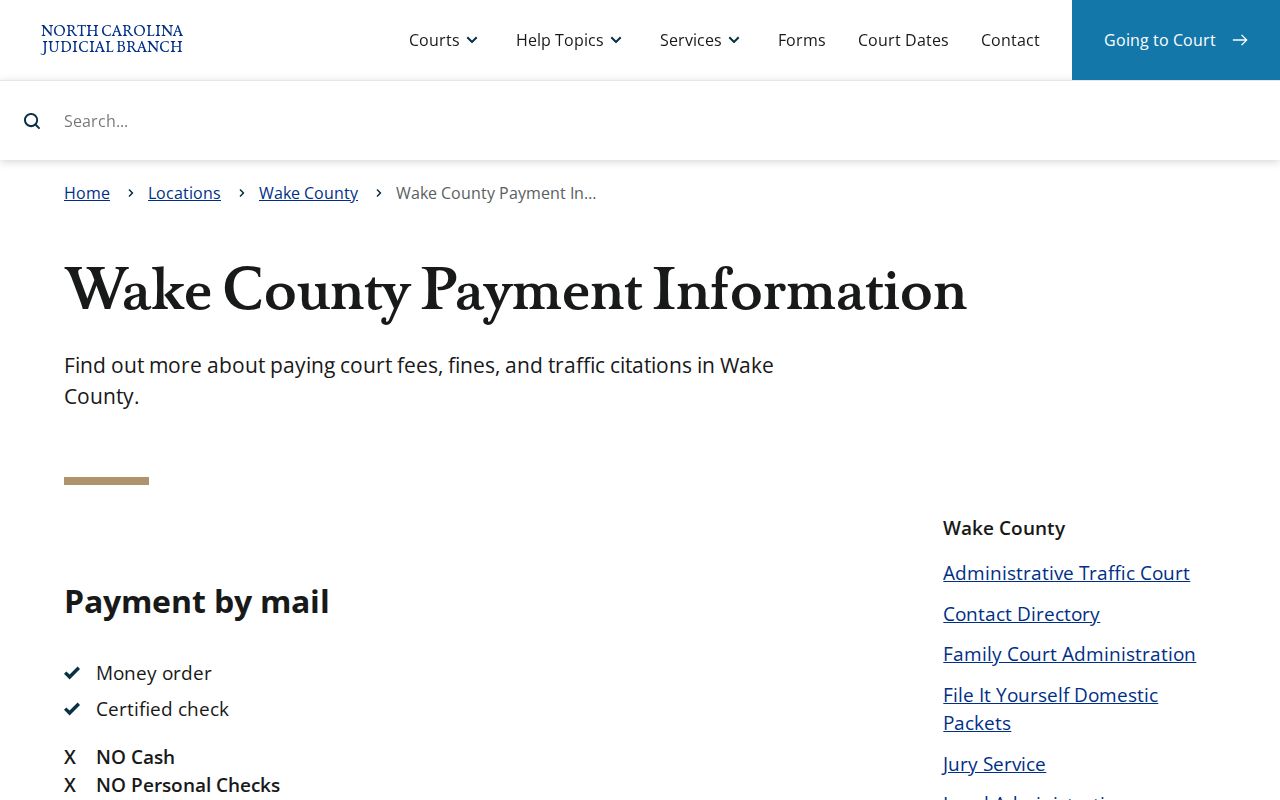
At the counter, the clerk accepts cash, major cards with processing fees, money orders, and certified checks, but not personal checks.
How a Criminal Case Moves
Wake County criminal cases do not all follow one exact schedule. A citation may avoid jail intake. A felony usually passes through early District Court work before a Superior Court indictment, while a misdemeanor can remain in District Court. Continuances, motions, competency issues, negotiations, and trial settings can change the path. The event log should be read as a sequence, not as a promise that every stage occurs on a fixed date.
Case flow: Charges Filed › Arraignment › Pretrial › Plea or Trial › Disposition › Sentencing
A magistrate may issue initial process and set release conditions. Prosecutors then decide which charges to file or pursue. For a Superior Court felony, the grand jury can return a true bill or no bill. The judge enters the final judgment after a plea or verdict. Appeals create another record layer and should not be mistaken for a new Wake trial file.
Missing Wake County Case Documents
A missing online document does not prove that no filing exists. Remote access varies by document and by the age or migration status of a case. Start by checking the case number, division, filed date, and name spelling. Then search the clerk terminal. If the event appears without an image, ask to inspect the paper file or order a copy from the Wake County records counter.
The paper file can answer whether the online index shortened a title, omitted an attachment, or did not expose the signed order. For a qualifying cleared case, use the certified order and the clerk's expunction line rather than trying to revive sealed data through search. The Judicial Branch expunction resources provide forms, while the official Chapter 15A expunction index, selected first-offender rule, and misdemeanor and felony rule show why the correct Wake County filing depends on the case.
After an expunction order, court and agency systems may update on different schedules, so a person reviewing their own record should verify each official source.
Wake County Traffic Court Records
Administrative Traffic Court in courtroom 101 handles eligible minor traffic dispositions on the scheduled date. It is not a trial session. Someone who contests an infraction must obtain a later trial setting when the officer can attend. The distinction matters because a calendar entry for administrative court does not show that evidence was heard or that guilt was decided at trial.
The Wake Administrative Traffic Court page gives the official process and current session details.
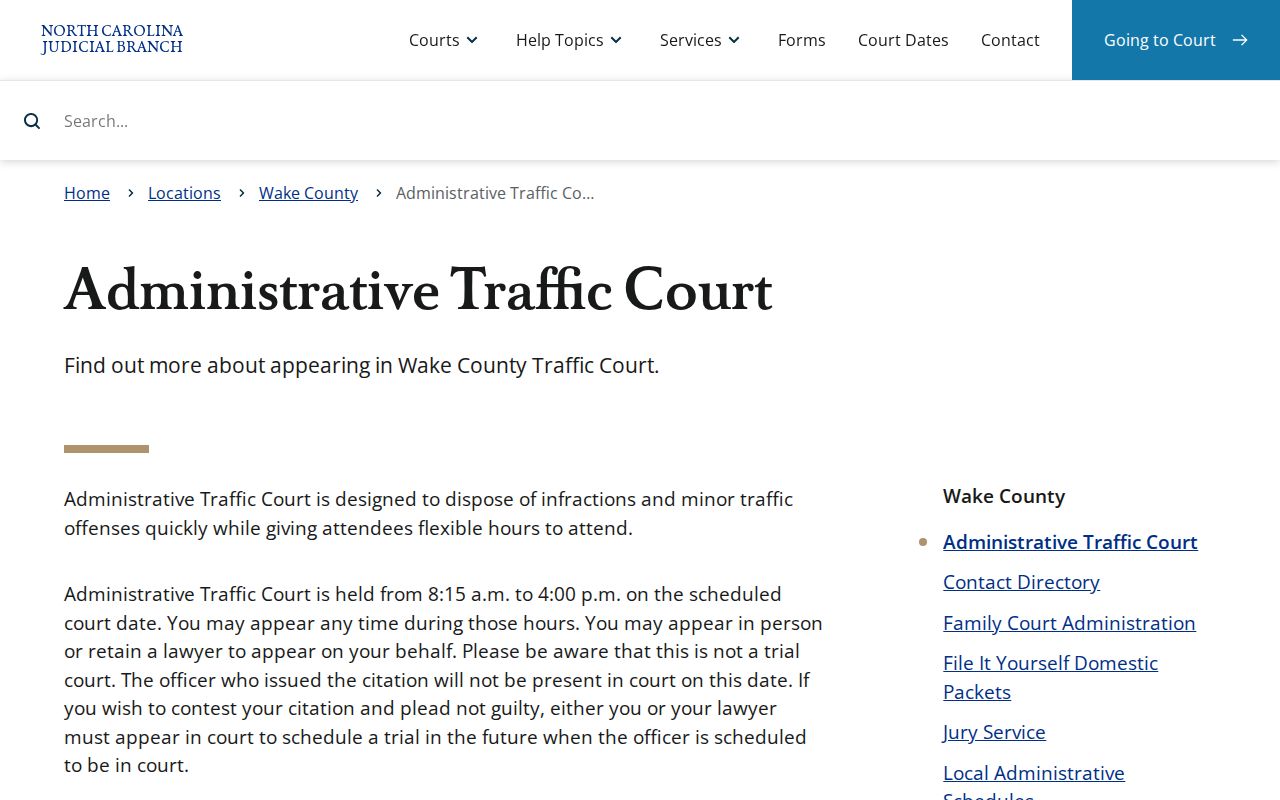
A traffic file can still contain a charge, scheduled event, disposition, and payment record. Read all of them before drawing a conclusion from the calendar label.
Case Record Access & Restrictions
G.S. 7A-109 keeps clerk records open for inspection during regular hours unless another law bars access. That rule supports Wake County court-file access, but it does not override expunction orders, juvenile confidentiality, sealed filings, or required redactions. Portal may also show less than the paper file even when the underlying material is public.
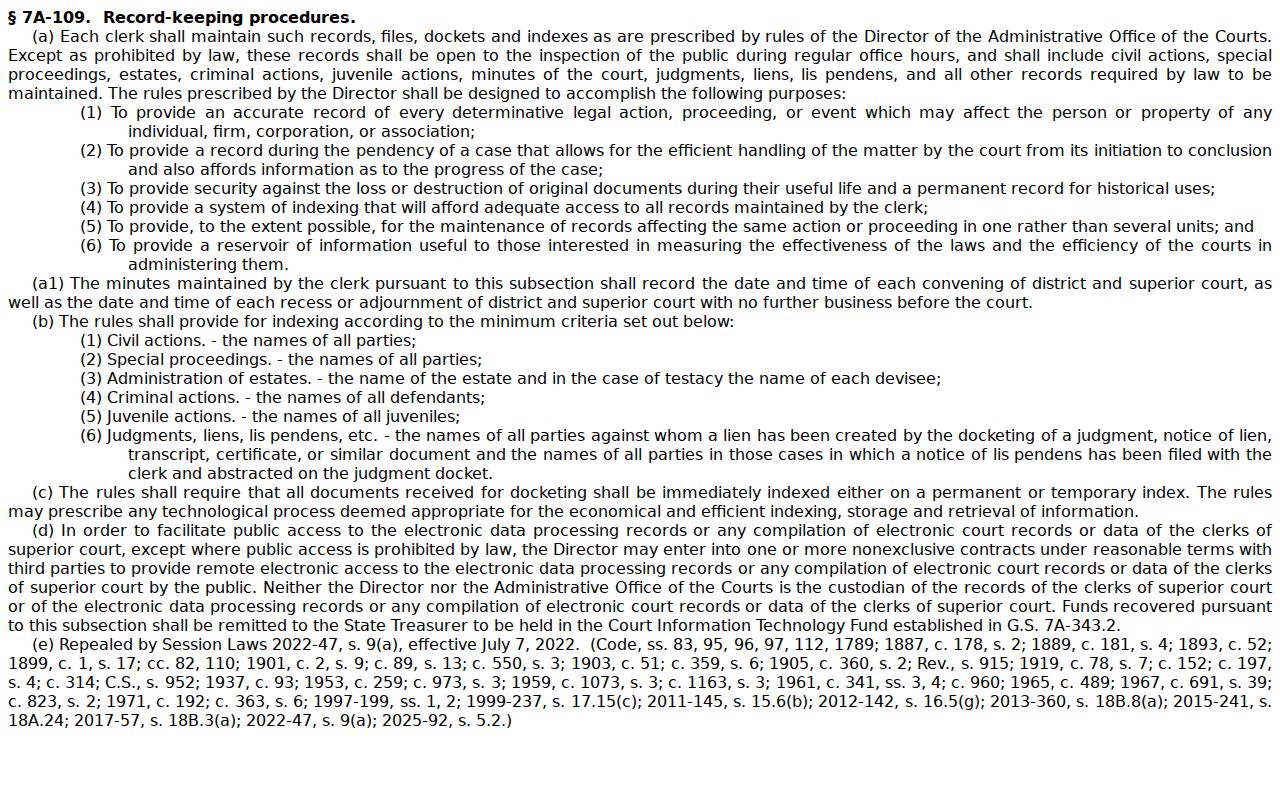
The statute frames clerk access, while Chapter 132 separately governs many agency records. Police investigative files are not converted into full public court files merely because a charge was filed.
When an arrest charge and filed charge differ, rely on the court file for what prosecutors pursued and how the judge resolved it. The booking entry still documents custody, but it cannot replace the later Wake County disposition. Juvenile records follow separate confidentiality rules. For an adult reviewing their own repository file, SBI's background-check questions and current Right to Review packet explain the state correction route. A reader tracing an earlier event can use the county's arrest lookup channels, then return to the court case for the result.